Masonic Articles and Essays
Is Mormonism a Child of Freemasonry?
Date Published:
11/24/2026
The historical relationship between Freemasonry and Mormonism raises profound questions about the inheritance and transformation of sacred symbolism. Through a Perennialist perspective, this article examines the relationship between historical origins, religious ceremonies, and the spiritual significance they acquire through lived experience. What does the origin of a ritual ultimately tell us about its spiritual value?
This month’s Masonic Seminar Lecture Series explored the question, “Is Mormonism a child of Freemasonry?” The presentation invited us to examine Joseph Smith’s relationship with the Craft and consider how his experiences might have informed the religious ceremonies he introduced.
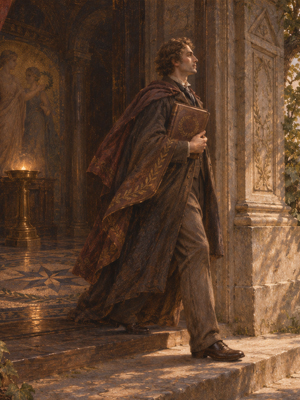 It is true that these historical questions deserve careful attention. However, after their consideration and exploration, I find myself drawn to another: What does a ritual’s origin tell us about its spiritual value? If Joseph Smith Jr. drew upon Freemasonry in shaping the Endowment Ceremony and other parts of his religion, how should we understand that influence? Would it diminish the meaning participants have found in the ceremony? Could the form of an inherited become a vehicle for a distinct religious vision?
To consider these questions, we must take the history seriously. An argument for influence requires more than identifying similarities. Biblical imagery appears in a myriad of different spiritual traditions, because they draw upon a shared sacred text. So, we come to understand what these similarities mean within the context of each faith. Even where a form is shared, its purpose and interpretation may differ. An apron, an obligation, or a symbolic action takes meaning from the story in which it appears. Instruction and circumstances of one’s own life help the initiate to understand that meaning. Tracing its source only furthers an inquiry into what people subsequently have made of it.
This is where my perspective as a Perennialist enters the discussion. I believe truth can be encountered throughout the world’s religious and spiritual traditions. Their teachings differ, sometimes profoundly, and those differences deserve consideration. Each offers particular ways of approaching human life, moral responsibility, and our relationship with the transcendent. For me, the recurrence of a symbol invites curiosity. Why has this image endured? What does it help people understand? How does its meaning change when it enters another religious setting?
Myth offers one approach to these questions. I use the word to describe a sacred narrative through which people explore their place in the world. Such a narrative can be examined historically while also serving as a framework for spiritual reflection. Its images may give expression to experiences that ordinary explanation struggles to convey.
Ritual brings that narrative into action. A participant assumes a role, makes a commitment, or moves through a symbolic sequence. The ceremony asks something of the person taking part. Its meaning may continue to unfold afterward, as the participant reflects upon the experience and attempts to live by the commitments made.
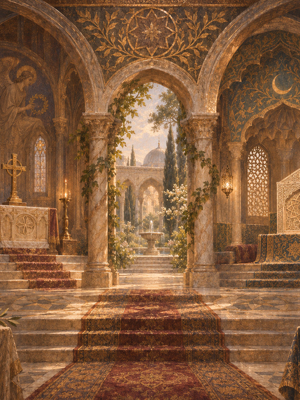 Historical origins and spiritual significance therefore require related but distinct judgments. A meaningful experience does not, by itself, prove a religion’s historical claims. Identifying an earlier source for a ceremony likewise leaves open the question of what participants may learn through it. Both inquiries deserve honesty.
I hesitate, then, to use “a child of Freemasonry” without examining what the phrase implies. A family metaphor suggests inheritance, but it can also imply a single line of descent. Applied to an entire religious movement, it may claim more than a comparison of particular ceremonies can establish. We need to identify what we believe was inherited and explain how it was transformed.
If Smith adapted forms he encountered in Freemasonry, what meanings did he give them? What did they enable him to communicate? What have members understood themselves to be undertaking through those forms?
These questions also turn us toward our own relationship with ritual. We enter a ceremony carrying expectations, doubts, and hopes. We encounter symbols whose histories extend beyond our individual lives. Understanding them requires us to consider their origins alongside the responsibilities they place upon us.
The seminar’s question leaves me reflecting on how traditions receive and reshape inherited symbols. Whatever conclusions we reach about their origins, we can still ask what they teach, what commitments they encourage, and how faithfully we carry those commitments into our lives.
More Masonic Articles
Explore articles and essays written by Freemasons about Freemasonry.
Read More
Membership
Interested in becoming a member of the worlds oldest Fraternal organization?
Read More