Universal Co-Masonry is governed by a Supreme Council composed of members invested with the 33rd and Last Degree of Freemasonry. From among its members, the Supreme Council elects the Most Sovereign Grand Commander, who holds office ad vitam and exercises supreme authority over all constituent Bodies of the Order.
The Grand Commander is charged with preserving the spiritual and moral integrity of the Order, administering its affairs, conducting relations with other Masonic Obediences, and supervising the workings of its constituent Bodies.
The office carries no remuneration and exists not for personal privilege, but for the fulfillment of the highest obligations of Masonic service.
Presented below are the present and former Most Sovereign Grand Commanders who have presided over the Order throughout its history.

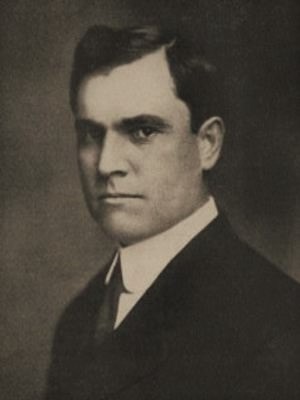
Antoine Muzzarelli, like many of the early members of American Co-Masonry was of French origin and had made his way to the New World
to seek his fortune in the land of opportunity. Born to a wealthy family, Muzzarelli was well educated and entered into a career in
the military. He first served as a captain in the Franco-Prussian War of 1870 and shortly afterwards against the Communards who had
occupied the city of Paris in 1871. In the midst of this violence and social upheaval Muzzarelli was made a Freemason. He was Initiated,
Passed and Raised in Loge La Sincerite in Bordeaux in January of 1871 and he served as the Right Worshipful Master of Loge La Parfaite
Egalite in Paris at least once.
He arrived in the United States on the shores of Philadelphia in 1876 and found work as a reporter, newspaper editor and French
teacher to the social elite. After a brief escapade as a war correspondent in Chile in 1877 he returned to New York City in 1880. A
man of many causes, Muzzarelli was ultimately a Freemason before all else and he dedicated himself to advancing French Masonry in
the United States. He began forming Lodges in the US on behalf of the Grand Orient de France before eventually coming into contact
with Le Droit Humain, the French precursor to what would eventually become Universal Co-Masonry. In 1903 he was appointed as the
representative of Le Droit Humain in the United States by Georges Martin himself and eventually he would be given the title of Lieutenant
Sovereign Grand Commander. He would serve in this position until his tragic death by suicide in 1908.
An energetic and industrious man, Muzzarelli was responsible for the establishment of Co-Masonry in the United States. Without his
tireless efforts it would not exist upon these shores, and it is to him that every Co-Mason owes a debt of gratitude. His was a life
lived in service to Freemasonry for its own sake and the honor and pride he took in the formation of the fledgling obedience is palpable
in the story of his life.

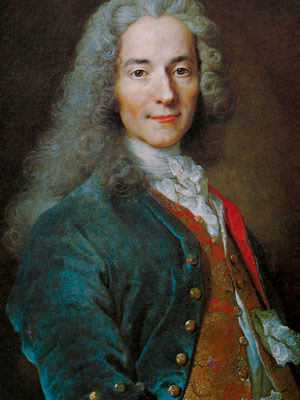
Louis Goaziou was born to a humble family on the Brittany coast of Northern France. The son of a shoemaker and textile worker, Goaziou
entered this world on March 22nd, 1864. His mother died when he was very young, and his father sent him to live with relatives who
saw to his education. Dissatisfied with the direction his young life was taking, Goaziou decided that America sounded interesting,
and he voyaged across the Atlantic with 4 of his friends, arriving penniless on the streets of New York City in 1881. With little more
than the shirt on his back, no knowledge of the English language and certainly no prospects in New York, Goaziou traveled to Pennsylvania
with his friends and soon found work where many European immigrants did at that time: in the mines.
Surrounded by dangers and inhumane working conditions Goaziou was desperate for other work but was unable to find any opportunities
outside of the mines. Dejected, he was determined to leave the United States forever when, on the eve of his departure, he met his
future wife and decided to remain in the United States, a decision that would cement the future of the yet unformed Universal Co-Masonry.
In 1902 he received a letter from Antoine Muzzarelli soliciting his aid in forming a Lodge in Goaziou’s home of Charleroi, Pennsylvania.
This would eventually become a reality in 1903 as Alpha Lodge No. 301 – the first Co-Masonic Lodge to be opened in North America and
the first Lodge of the Order that would eventually become Universal Co-Masonry.
It was Louis Goaziou who presided over the purchase of the land in Larkspur, Colorado upon which the headquarters of our Order still
stands today. Goaziou opened dozens, if not hundreds, of Lodges across the country and was responsible for the meteoric growth of the
Order. Whether consciously or not, Goaziou was establishing a distinctly American form of Le Droit Humain that would persist for
nearly a century after his death and that still stands today.
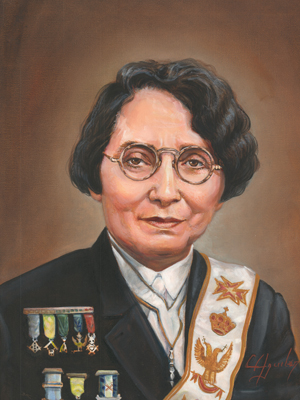
Edith Armour was not a physically imposing woman, standing a little under 5 feet tall, but was so strong a character as to be a force
to be reckoned with. Her strength would guide the Federation through some of the darkest years of its existence.
Facing a sharp decline in membership after the death of Goaziou, Armour assumed the leadership of a Federation in chaos. She began her
administration with a year long tour of the United States, visiting as many Lodges as she could behind the wheel of her car nicknamed
“Old Hiram”. Famous for the Smith and Wesson revolver she carried on this voyage, Armour restored faith in the Federation and American
Co-Masonry wherever she went. She assumed office in the midst of the Great Depression and would preside over the Order during the dark
days of World War Two.
It was during her term of service that Theosophical membership in the Order would dramatically increase. As many of the Lodges that
Muzzarelli and Goaziou started during their respective terms closed, Armour’s encouragement of Theosophical interest in the Craft of
Freemasonry would sustain the membership throughout the 1940s. It was under the leadership of Armour that the American Federation
would institute its first Mark Lodge and its first Chapter of the Holy Royal Arch of Jerusalem, Armour having received these degrees
directly form the President of the Theosophical Society – Curuppumullage Jinarajadasa.
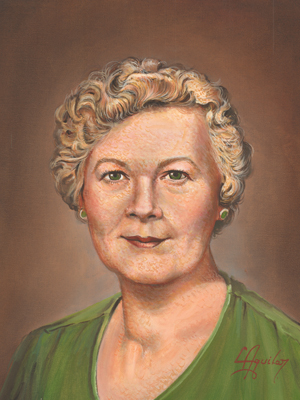
Initiated in 1942, Bertha Williams was a quite and reserved woman who dutifully served the Federation for over 25 years. A gentle spirit
given to poetry and the arts, hers was an administration of preservation and stability. She presided over a general decline of interest
in the occult world that Freemasonry was a part of generally, with a decline in the Theosophical Society taking place around the same time.
Yet Bertha Williams never wavered in her commitment to her duty as not only Most Puissant Grand Commander but as the President of the
American Federation of Human Rights. Relocating to Larkspur, Colorado, Williams lived on the property which was at that time still a very
rural area and weathered the winter storms and summer floods alike to preserve the Federation at all times. She was assisted in her work
by her lifelong friend and predecessor Edith Armour until her failing health no longer permitted her to give her aid.
Bro. Bertha never let the demands of her office dull her sensitivity to the higher regions from which she drew her art. During her reign
she wrote "Covenant with Light" — a beautiful poetic anthology which includes musings upon Freemasonry, Humanity, and the Divine. It is
transparent, from both the life that she lived and the poetry she left as her legacy, that Bertha Williams was a resplendent example of
all that a Co-Mason should attempt to become — tireless, gentle, intuitive, completely overcome with an adoration of God and the entirety
of his creation.
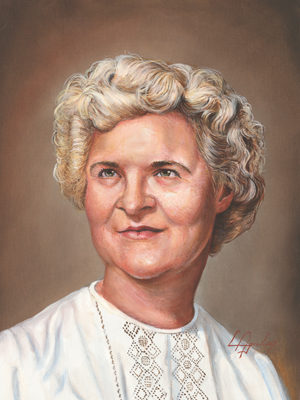
Helen Wycherley would prove to be a pivotal figure in the history of the American Federation of Le Droit Humain. Not only would she initiate
the very beginning of the renewal of American Co-Masonry, but she would become a mentor to some of those members who would alter the
Federation forever in 1994.
Born Helen Palmer Owen in Winchester, Kentucky she became Helen Wycherley after marrying James Wycherley, a fellow Co-Mason. Though their
marriage would not last her commitment to Co-Masonry certainly would. Initiated, Passed and Raised in 1940 in Sirius Lodge No. 556
Wycherley would serve as Grand Secretary, Grand Treasurer, Grand Orator, Deputy of Southern California and Special Deputy of the M.P.G.C.
throughout her career before receiving the 33rd Degree in 1967 and taking up the mantle of Grand Commander herself in 1968.
She began her administration with a letter to the members of the Federation calling for a renewal of enthusiasm for Freemasonry for its
own sake and would spend much of her term in office dedicated to making this idea a reality. An excellent ritualist and committed Freemason
she would travel constantly for the Federation, instructing Lodges in ritual work and writing letters full of esoteric observation and
ritual interpretation. Helen Wycherley’s legacy would be one of service and dedication to the idea of Co-Masonry and her influence is
still deeply felt in Universal Co-Masonry today.
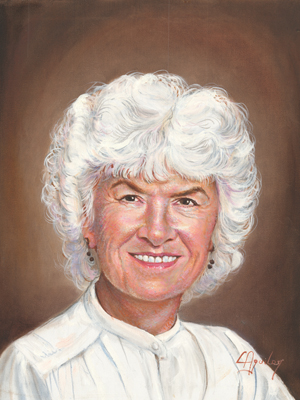
Calla Haack was handpicked by Helen Wycherley to succeed her as Most Puissant Grand Commander. Initiated and Passed in 1975, she was raised
to the Sublime Degree of Master Mason in 1976. Strikingly beautiful, intelligent and a very competent ritualist, Haack quickly caught
Wycherley’s eye and was groomed for leadership early in her Masonic career.
Haack advanced through the ranks very quickly, reaching the 33rd degree in 1983, only 8 years after her initiation and only a few months
after she had received the 32nd degree in January of that same year. Such a rapid advancement was rare and would later prove to have
been entirely too rapid.
It was during her reign that tensions between the American Federation and the Supreme Council of Le Droit Humain in Paris would come to
a head. After the situation between Paris and Larkspur became untenable, several members of the American Federation – with the support
of most of the members of the 32nd Degree – would decide to break away from the leadership in Paris and establish American Co-Masonry as
its own independent Masonic Obedience. Haack would stay with Le Droit Humain but would soon retire from the Masonic life. Though in office
during what would become known as “The Split” Haack nonetheless fulfilled the duties of her office with poise and dignity.
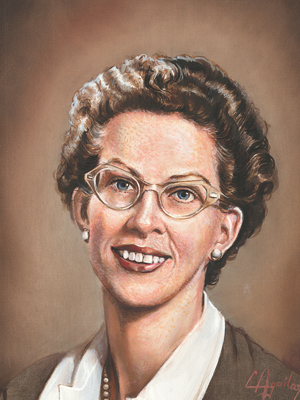
Born October 9th, 1920, Joy Mills was an extraordinary figure of Co-Masonic history. Joy Mills was first and foremost a dedicated Theosophist.
She joined the Milwaukee Lodge of the Theosophical Society of America in 1940 and quickly became extremely active within the organization.
She would go on to be a very prolific Theosophical writer and speaker authoring nearly a dozen books and numerous Theosophical pamphlets
and articles. She was a much sought after speaker both within the United States and internationally.
Initiated into Amen-Ra Lodge No. 554 of Milwaukee in 1942, Joy Mills was a Co-Mason of considerable commitment, not only attaining the 33rd
degree but remaining a Mason for 73 years. She would serve in the highest capacity of our Order twice in her life in times of great need.
In 1970 she would serve as the Deputy Most Puissant Grand Commander until Helen Wycherley stepped up to lead the Order after the retirement
of Bertha Williams and again would serve as the interim Most Puissant Grand Commander in 1992 before the appointment of Vera Bressler by
the Supreme Council in Paris. A devoted and enthusiastic Co-Mason, Joy Mills will always be remembered for her quick and eager response
to the call of Masonic Service.
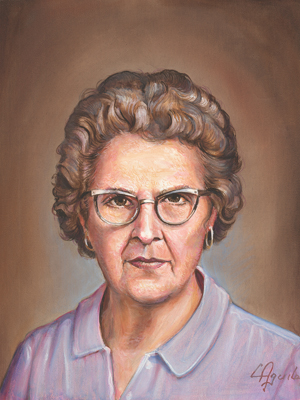
Very little is known of Vera Bressler. A prominent Theosophist around the middle of the 20th century – serving as the Vice Chair of the
Krotona Institute for Theosophy - she was nearly 80 years old at the time she assumed the office. The Order had been thrown into chaos
by the resignation of Calla Haack and Bressler’s appointment by the Supreme Council in Paris marked a radical departure from tradition
that would ultimately result in the Split.
For decades, the Most Puissant Grand Commander of the American Federation of Le Droit Humain had appointed their successor and the Supreme
Council in Paris had always approved that successor. After Haack resigned without choosing a successor, an election was held by the North
American Consistory for the first time in the Order’s history between three candidates – Vera Bressler, Rosario Menocal and Magdalena
Cumsille. Although Bressler only managed to obtain 6% of the vote she was chosen as Haack’s successor by the Supreme Council in Paris. Her
leadership would prove unpopular, she was inactive at the time of her appointment and had initially refused to accept the office, and
ultimately she was the last Grand Commander of the American Federation under the dominion of the Supreme Council in Paris.
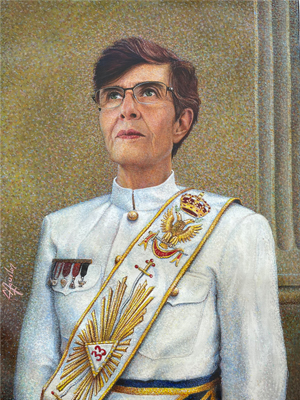
María Magdalena Ibañez Cumsille was born on November 23, 1946, in Santiago, Chile. She spent her twenties and early thirties
living abroad in several countries of South America. It wouldn’t be until she arrived in the United States that
she and her husband Elias Maxímo Cumsille would become Freemasons. At the age of 33 years old, the Theosophist and student
of the Occult, along with her husband, would be Initiated in Orpheus Lodge No. 553 of Le Droit Humain in Baltimore, MD.
The same Lodge that she would be Passed and Raised in. Bro⸫ Cumsille would go on to have an illustrious Masonic career.
A gifted ritualist and artist, she took naturally to Freemasonry. She was made the Master of Phoenix Lodge in Connecticut and reached the
32nd degree in 1991. Bro⸫ Cumsille served as the Deputy of the Midwestern District of the Federation from 1986 to 1991
and of the Eastern District from 1992 to 1994. She held principal offices in numerous Blue Lodges, Mark Lodges, Chapters of
the Holy Royal Arch of Jerusalem, and various bodies of the Scottish Rite while also fulfilling the offices of Grand Director
of Ceremonies and Secretary of the American Federation.
A protege and close friend of the previous Grand Commander; Helen Wycherley, Bro⸫ Cumsille knew early on that Freemasonry would become
the central focus of her life. It would be in 1994 that she would assume the ultimate role of Most Sovereign Grand Commander
of Universal Co-Masonry, an office that required her to preside over this institution as it reached into unknown
frontiers after Le Droit Humain and the American Federation parted ways.
From ritualistic discipline and regalia, to nearly every aspect of Co-Masonry, she has improved The Order by her leadership and
positive influence. Numerous Lodges have been reinvigorated and new Triangles and Lodges have been established and
instituted across the United States, Central and South America, and the Philippines, with more Triangles and Lodges
in the works. Under her administration, the Masonic Philosophical Society was created and now holds study centers
across the world and online, and the Masonic Seminar was launched to bring a clearer understanding of the reality
of Freemasonry to those who wish to join its ranks. Bro⸫ Magdalena I. Cumsille was,
and continues to be, a beacon of leadership, discipline, and hope, as Co-Masonry spreads at a rate that
has not been seen since the days of Bro⸫ Louis Goaziou all those years ago.