Masonic Articles and Essays
The Talents of the Craft
Date Published:
9/18/2026
The Parable of the Talents offers the Mason a powerful allegory of labor, stewardship, and spiritual increase. What has been entrusted to us must be cultivated, exercised, and returned enlarged through faithful service. What do we make of the gifts placed within our keeping?
The world which we inhabit, both material and spiritual, is the consequence of activity. We dwell within a living and animated universe, wherein all things move according to law, and wherein the very order of creation appears to depend upon ceaseless motion, transmission, and renewal. God, the Great Architect of the Universe, has set forth the heavens and the earth according to His wisdom, and by the continual outpouring of His power the pillars of creation are sustained. Life itself bears witness to this divine activity, for wherever life is found there also are motion, increase, and work.
The celestial labor of angels, of the saints triumphant, and of all souls who aspire toward sanctity may be regarded as the magnification of this divine outpouring. Receiving from above, they transmit that which has been received; illumined themselves, they bear light into regions yet darkened; and by prayer, service, and spiritual attainment they become instruments through which the higher life is carried into the world of men. The good which descends from God thus becomes fruitful through those who receive it faithfully and give it forth again enlarged by conscious participation in His work.
Our own labor is likewise to be accomplished here, upon the earth and among our fellow men. The kingdom of heaven is no remote province severed from the conditions of daily life. Its foundations are laid within the duties which lie nearest to us, and its laws are made visible wherever intelligence is joined to virtue and power is governed by conscience. What has been entrusted to us must therefore find expression in conduct, for the spiritual life which remains barren of action has failed to fulfill the purpose of its reception.
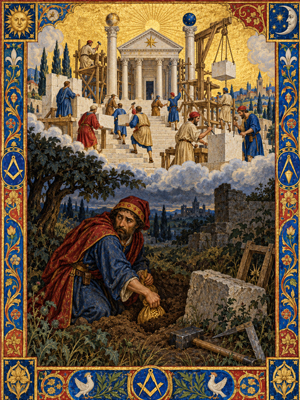 Among the clearest scriptural representations of this principle is the Parable of the Talents, contained in the Gospel according to Matthew, 25:14–30. A master, departing upon a journey, entrusts portions of his wealth to three servants according to their several abilities. Two employ what they have received and return it increased; the third, overcome by fear, buries his portion in the earth and restores it unchanged. The parable has long invited moral and symbolic interpretation, and its lesson deserves the serious consideration of every Mason, for it concerns the right use of those powers which Providence has placed within our keeping.
Read as an esoteric allegory, the talents may be understood as the faculties entrusted to the human soul and the powers which each man is bound to cultivate through worthy use. Knowledge, strength, and courage belong to this interior treasury. So also do intelligence, sympathy, and discipline, together with every opportunity for useful service. They are ours in stewardship, and their worth is revealed according to the measure in which they are exercised, enlarged, and consecrated to worthy ends.
Freemasonry expresses this same principle through the ancient language of labor. The Mason is given a task and the means by which to accomplish it. The stone must be worked with patience and skill, and the Temple can rise only through faithful effort directed according to a design. The symbolism is simple, yet its application extends through the whole of moral life. That which is rough must be shaped; that which is weak must be strengthened; that which is incomplete must be carried forward by discipline and perseverance. Every faculty becomes more valuable when it is brought under order and made serviceable to the work.
The marketplace in which the faithful servants increase their lord’s wealth may likewise be regarded as an image of the world itself, wherein men meet and exchange the fruits of thought, experience, and labor. Each brings something gathered through his own trials and observations, and each may receive in turn something which he could not have acquired alone. Through association and instruction the individual treasury is increased, while friendship and service enlarge the common wealth of human understanding.
The Lodge possesses something of this same character. It is a place of meeting and of common labor, wherein persons of differing gifts and degrees of attainment are brought within a common order. Each enters bearing some portion of experience and some capacity for usefulness, together with faculties capable of further cultivation. Knowledge is enlarged through communication, judgment through intercourse, and virtue through exercise. The Mason who enters the Lodge with sincerity therefore enters a field of labor wherein that which has been acquired inwardly may be offered for the benefit of others, while the wisdom and experience of his Brethren may contribute to the enlargement of his own understanding.
To dig in the earth and hide that which has been given to us is therefore a grave failure of stewardship. Our spiritual faculties were bestowed that they might be exercised and increased. When buried in selfishness, indifference, or excessive attachment to material things, they remain barren and unfruitful.
The image of the buried talent is severe because it is exact. The earth receives the treasure and returns it as it was. Nothing has been added, for nothing has been attempted. In like manner, the working tool which is never taken in hand performs no office, and the stone which remains untouched retains every roughness with which it was first found. Knowledge withheld from useful employment becomes sterile; courage weakens through disuse; and charity, when confined to sentiment, produces no amendment in the condition of mankind.
The fearful servant therefore presents a warning of particular gravity. His mind is so occupied by the prospect of punishment that he neglects the work entrusted to him. Fear arrests effort and persuades the soul to preserve its little store rather than expose it to the hazards of worthy employment. Yet the parable teaches that preservation without increase constitutes a failure of duty. The servant was charged with a portion of the master’s wealth because something was expected of his stewardship.
.jpg) Mankind has been given a peculiar office within creation, for through human thought and action the moral order may be made visible upon the earth. We possess the power to shape matter and to establish institutions. We may communicate knowledge, administer justice, and relieve suffering. Freemasonry gives this duty an architectural form, teaching us to regard ourselves as workmen within a Temple whose complete design exceeds our sight, while the portion committed to our hands remains wholly within the sphere of our responsibility.
Mankind has been given a peculiar office within creation, for through human thought and action the moral order may be made visible upon the earth. We possess the power to shape matter and to establish institutions. We may communicate knowledge, administer justice, and relieve suffering. Freemasonry gives this duty an architectural form, teaching us to regard ourselves as workmen within a Temple whose complete design exceeds our sight, while the portion committed to our hands remains wholly within the sphere of our responsibility.
Herein lies one of the most solemn lessons of the parable. The servant is judged according to the use which he makes of that which was entrusted to him. Each receives according to his capacity, and each is answerable for the fidelity with which he employs his portion. So also within the Craft every Mason possesses some share in the common labor. One brings learning, another steadiness of character, and another practical skill. Others may possess eloquence or the quiet capacity to strengthen those about them. Each gift acquires dignity when faithfully employed.
Abundance follows activity, while stagnation brings loss. Therefore, be not afraid. Go forth and do the work. Increase that which has been entrusted to you, strengthen the faculties which Providence has placed within your keeping, and employ them for the welfare of your Brethren and of mankind.
The Mason who receives light assumes with it a corresponding duty. He must enlarge it through understanding, embody it in conduct, and carry its influence outward through useful labor. What has been received must pass again into the world increased by discipline, experience, and service.
In such labor we may find some clue to the work of the angels. Light becomes fruitful through transmission, the talent through increase, and the stone through the hand that faithfully shapes it. Thus is the Temple raised, stone by stone, within the soul and the Lodge, and thence within the world.
More Masonic Articles
Explore articles and essays written by Freemasons about Freemasonry.
Read More
Membership
Interested in becoming a member of the worlds oldest Fraternal organization?
Read More
