Masonic Articles and Essays
The Winged Egg: Myth, Mystery and Freemasonry
Very Illus..... Bro... Pamela McDown 33°
Date Published:
1/1/1900
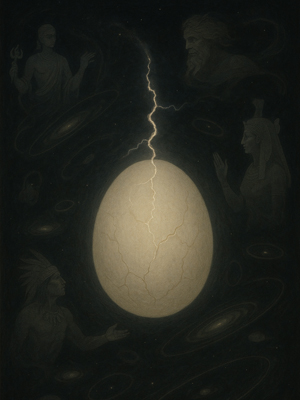
A luminous Cosmic Egg stirs in the darkness before creation, cracked by the first spark of life. Around it move shadowed figures from the world’s oldest myths, each hinting at a forgotten story of origins. What does this primordial symbol reveal about how life, order, and consciousness emerge from secrecy and pressure?
 Many sense that our world is entering a moment of profound transformation. Something is shifting beneath the surface. What once felt solid now shows its fractures. Ideas revered for generations strain under new questions, and the systems that shaped identity and purpose no longer contain the fullness of who we are becoming.
Yet hidden within this turbulence, an ancient symbol quietly endures, a sign recognized by the wisdom traditions of Egypt, India, and Greece, and later preserved within the higher degrees of Egyptian Rite Freemasonry: the Winged Egg.
This mysterious emblem suggests that creation is not finished. It is in the very act of awakening. What we call collapse may simply be the first stirring of wings.
As the shell of the present age begins to crack, what deeper meanings might the Winged Egg reveal about the future now forming within us?
The Cosmic Egg: The First Story Ever Told
According to many ancient traditions, the universe was not born from chaos exploding outward, but from something quieter and more mysterious: an egg. In one story told by the Cahuilla people, the darkness of space struggled three times to give birth, until a bolt of lightning awakened the mother substance and produced two great cosmic eggs. When they cracked open, twin creators emerged and shaped the world above and below.
This is only one version of a myth found all around the world. Nearly every ancient culture saw the egg as the most powerful symbol of creation, renewal, and immortality. In Russia and Scandinavia, clay eggs were placed in graves for the same reason: life does not end, it transforms.
In India, the universe itself is said to have come from a radiant “Golden Egg” that hatched into heaven and earth. The Greeks imagined the egg as a vault of space holding the seven layers of existence, while Chinese myths describe a great cosmic bird dropping the first egg of humanity into the dark waters before the world existed.
No matter where the story is told, the message is the same: life begins in secret, hidden inside the shell of potential.
Even science quietly agrees. The human egg already contains all the elements needed for life, and the spark that touches it simply awakens what is already present. Growth begins long before it can be seen. The ancients, looking to the stars, saw this same pattern in the skies. The oval path of heavenly bodies and the invisible sphere of light around all living things reflect the shape of an egg, the universe wrapped around itself, preparing to unfold.
Because of this, the egg was more than myth. It was seen as the very blueprint of creation. As the cosmic egg cracks open into galaxies, the human egg divides into cells. As Spirit breathes meaning into matter, so life awakens within the womb. “As above, so below,” the sages would say. The pattern is one.
What lessons can we learn from these tales? What potential lies within the present moment of humanity that has not yet revealed its purpose?
The Winged Egg in Egyptian Rite Freemasonry
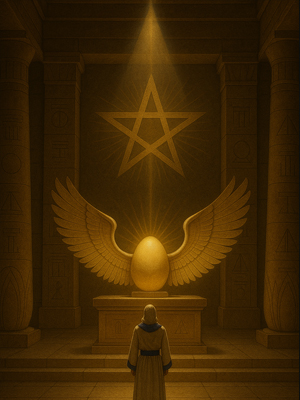 Although the winged egg does not appear within Craft Masonry, it emerges as a central emblem in the Egyptian Rite traditions still practiced today. In the Rite of Memphis-Misraïm, several higher degrees bear this symbol upon their jewel, inviting the initiate to recognize a profound truth: they are both child of the primordial matrix and builder of the inner Temple. What the ancient Egyptians depicted as the first spark of creation, Freemasonry reframes as a call to transformation and the birth of the spiritual Self.
The winged egg unites two great symbols of antiquity: the cosmic egg found across world mythologies as the womb of existence, and the winged solar globe of Egypt, which signifies spirit, ascension, and divine authority. Even the winged scarab pushing the sun egg toward its daily rebirth echoes this synthesis.
Within the Egyptian Masonic setting, this emblem operates on several levels of initiation wisdom.
1. Primordial Creation - The egg signifies the origin of life and consciousness, the undivided One that gives rise to the many. For the initiate, it represents the pre-differentiated state before the Work begins, pure potential awaiting the light of discovery.
2. Spirit in Motion - The wings introduce movement and purpose. Spirit does not remain latent. It rises, lifts, and unfolds. The winged egg teaches that the world is not merely born but is destined to ascend. Likewise, the initiate must rise above the inertia of matter and awaken to a higher plane of being.
3. Union of Opposites - In many Memphis-Misraïm degrees, the winged egg appears with other geometrical glyphs such as the circle, square, triangle, and sometimes the letter G shining at the center of a rayed triangle. Here the symbol becomes a blueprint of integration, combining origin and potential, spirit and motion, intelligence and form. Matter, spirit, and mind are united within the builder’s sacred art.
Thus, the winged egg becomes a powerful allegory for the journey of initiation itself. It represents the cracking of the shell of the profane self and the emergence of light from darkness, the passage from inert potential into living mastery. At this stage, the initiate does not merely learn truth. They become truth.
In the alchemical tradition, this is the Philosophical Egg, the sealed vessel of the Great Work. In Freemasonry, the degrees become its wings. Through trial and refinement, the soul frees itself from ignorance and rises into a fuller realization of its divine purpose.
Helena Blavatsky, herself a Freemason, described this evolution in detail in her Secret Doctrine. She notes that the egg symbolizes the universe in latency, while the wings symbolize the universe in motion, Spirit taking flight toward higher planes of cognition.
We may therefore ask a timely question. Could the pressure of our present age be the very force required to crack the shell of our collective soul? Perhaps the upheavals of our time are not signs of collapse but the first tremors of a greater birth.
Is a New World Hatching?
When we look at our world today, its tensions, upheavals, and the shaking of foundations once thought immovable, it can feel as though everything familiar is breaking apart. Yet the ancient symbol of the winged egg invites a different interpretation: what appears as ruin may, in truth, be the sacred cracking of emergence.
An eggshell fractures not because life is ending, but because life has outgrown its container. So, too, the structures of the past, political, social, philosophical, and even religious, split open when Spirit presses forward and refuses to remain confined. Evolution insists on flight.
The winged egg might teach us that the universe is not static. It is a living architecture of continual becoming. Every egg tells the same story: darkness stirring into light, silence awakening into sound, the unseen preparing to be revealed. First quietly, then suddenly and with irrepressible force, the new breaks forth.
Humanity stands at the threshold of transformation, enclosed in a shell that can no longer contain what we are becoming. A higher vision presses from within, asking for courage, creativity, and trust. Is a new world hatching? It depends on whether we choose fear of the breaking, or faith in the emergence, and whether we claim our duty as builders of the Light that seeks to be born.
More Masonic Articles
Explore articles and essays written by Freemasons about Freemasonry.
Read More
Membership
Interested in becoming a member of the worlds oldest Fraternal organization?
Read More
