
Masonic, Occult and Esoteric Online Library
Thought Forms
By Annie Besant
Illustrative Thought-Forms
AFFECTION
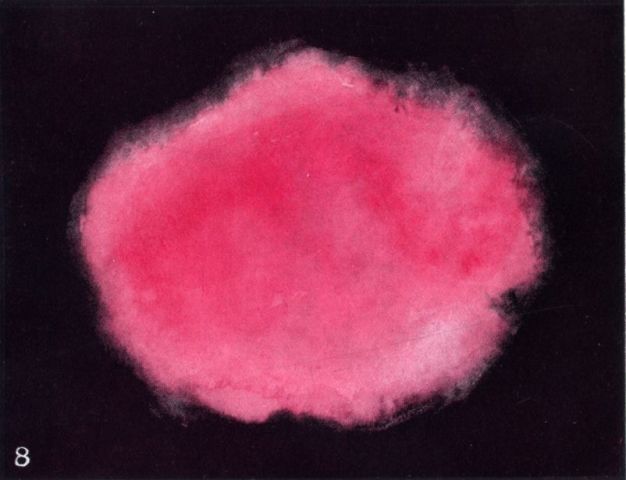
Vague Pure Affection.—Fig. 8 is a revolving cloud of pure affection, and except for its vagueness it represents a very good feeling. The person from whom it emanates is happy and at peace with the world, thinking dreamily of some friend whose very presence is a pleasure. There is nothing keen or strong about the feeling, yet it is one of gentle well-being, and of an unselfish delight in the proximity of those who are beloved. The feeling which gives birth to such a cloud is pure of its kind, but there is in it no force capable of producing definite results. An appearance by no means unlike this frequently surrounds a gently purring cat, and radiates slowly outward from the animal in a series of gradually enlarging concentric shells of rosy cloud, fading into invisibility at a distance of a few feet from their drowsily contented creator.
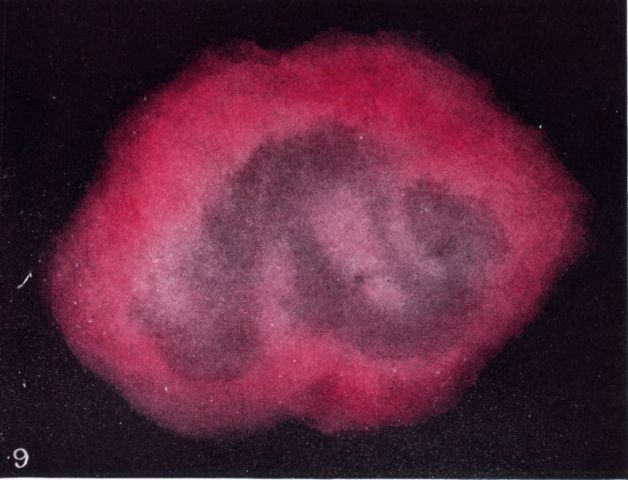
Vague Selfish Affection.—Fig. 9 shows us also a cloud of affection, but this time it is deeply tinged with a far less desirable feeling. The dull hard brown-grey of selfishness shows itself very decidedly among the carmine of love, and thus we see that the affection which is indicated is closely connected with satisfaction at favours already received, and with a lively anticipation of others to come in the near future. Indefinite as was the feeling which produced the cloud in Fig. 8, it was at least free from this taint of selfishness, and it therefore showed a certain nobility of nature in its author. Fig. 9 represents what takes the place of that condition of mind at a lower level of evolution. It would scarcely be possible that these two clouds should emanate from the same person in the same incarnation. Yet there is good in the man who generates this second cloud, though as yet it is but partially evolved. A vast amount of the average affection of the world is of this type, and it is only by slow degrees that it develops towards the other and higher manifestation.
Definite Affection.—Even the first glance at Fig. 10 shows us that here we have to deal with something of an entirely different nature—something effective and capable, something that will achieve a result. The colour is fully equal to that of Fig. 8 in clearness and depth and transparency, but what was there a mere sentiment is in this case translated into emphatic intention coupled with unhesitating action. Those who have seen the book Man Visible and Invisible will recollect that in Plate XI. of that volume is depicted the effect of a sudden rush of pure unselfish affection as it showed itself in the astral body of a mother, as she caught up her little child and covered it with kisses. Various changes resulted from that sudden outburst of emotion; one of them was the formation within the astral body of large crimson coils or vortices lined with living light. Each of these is a thought-form of intense affection generated as we have described, and almost instantaneously ejected towards the object of the feeling. Fig. 10 depicts just such a thought-form after it has left the astral body of its author, and is on its way towards its goal. It will be observed that the almost circular form has changed into one somewhat resembling a projectile or the head of a comet; and it will be easily understood that this alteration is caused by its rapid forward motion. The clearness of the colour assures us of the purity of the emotion which gave birth to this thought-form, while the precision of its outline is unmistakable evidence of power and of vigorous purpose. The soul that gave birth to a thought-form such as this must already be one of a certain amount of development.

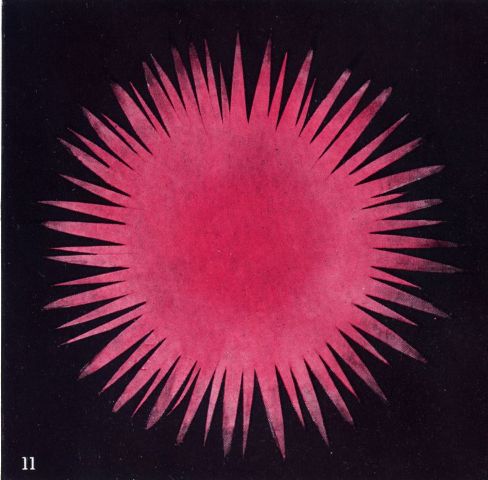
Radiating Affection.—Fig. 11 gives us our first example of a thought-form intentionally generated, since its author is making the effort to pour himself forth in love to all beings. It must be remembered that all these forms are in constant motion. This one, for example, is steadily widening out, though there seems to be an exhaustless fountain welling up through the centre from a dimension which we cannot represent. A sentiment such as this is so wide in its application, that it is very difficult for any one not thoroughly trained to keep it clear and precise. The thought-form here shown is, therefore, a very creditable one, for it will be noted that all the numerous rays of the star are commendably free from vagueness.
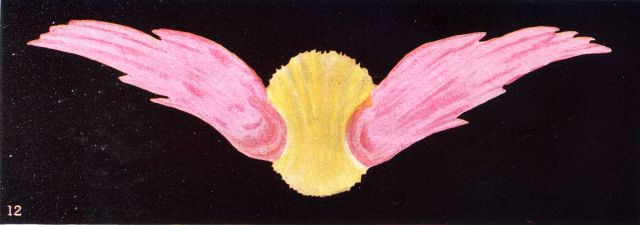
Peace and Protection.—Few thought-forms are more beautiful and expressive than this which we see in Fig. 12. This is a thought of love and peace, protection and benediction, sent forth by one who has the power and has earned the right to bless. It is not at all probable that in the mind of its creator there existed any thought of its beautiful wing-like shape, though it is possible that some unconscious reflection of far-away lessons of childhood about guardian angels who always hovered over their charges may have had its influence in determining this. However that may be, the earnest wish undoubtedly clothed itself in this graceful and expressive outline, while the affection that prompted it gave to it its lovely rose-colour, and the intellect which guided it shone forth like sunlight as its heart and central support. Thus in sober truth we may make veritable guardian angels to hover over and protect those whom we love, and many an unselfish earnest wish for good produces such a form as this, though all unknown to its creator.
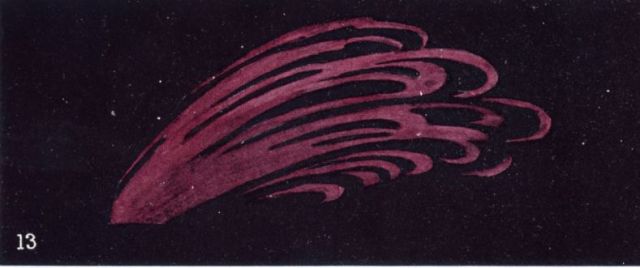
Grasping Animal Affection.—Fig. 13 gives us an instance of grasping animal affection—if indeed such a feeling as this be deemed worthy of the august name of affection at all. Several colours bear their share in the production of its dull unpleasing hue, tinged as it is with the lurid gleam of sensuality, as well as deadened with the heavy tint indicative of selfishness. Especially characteristic is its form, for those curving hooks are never seen except when there exists a strong craving for personal possession. It is regrettably evident that the fabricator of this thought-form had no conception of the self-sacrificing love which pours itself out in joyous service, never once thinking of result or return; his thought has been, not "How much can I give?" but "How much can I gain?" and so it has expressed itself in these re-entering curves. It has not even ventured to throw itself boldly outward, as do other thoughts, but projects half-heartedly from the astral body, which must be supposed to be on the left of the picture. A sad travesty of the divine quality love; yet even this is a stage in evolution, and distinctly an improvement upon earlier stages, as will presently be seen.
DEVOTION
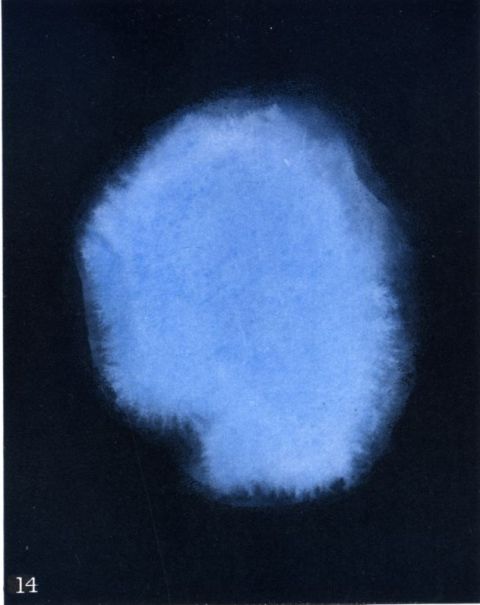
Vague Religious Feeling.—Fig. 14 shows us another shapeless rolling cloud, but this time it is blue instead of crimson. It betokens that vaguely pleasurable religious feeling—a sensation of devoutness rather than of devotion—which is so common among those in whom piety is more developed than intellect. In many a church one may see a great cloud of deep dull blue floating over the heads of the congregation—indefinite in outline, because of the indistinct nature of the thoughts and feelings which cause it; flecked too often with brown and grey, because ignorant devotion absorbs with deplorable facility the dismal tincture of selfishness or fear; but none the less adumbrating a mighty potentiality of the future, manifesting to our eyes the first faint flutter of one at least of the twin wings of devotion and wisdom, by the use of which the soul flies upward to God from whom it came.
Strange is it to note under what varied circumstances this vague blue cloud may be seen; and oftentimes its absence speaks more loudly than its presence. For in many a fashionable place of worship we seek it in vain, and find instead of it a vast conglomeration of thought-forms of that second type which take the shape of material objects. Instead of tokens of devotion, we see floating above the "worshippers" the astral images of hats and bonnets, of jewellery and gorgeous dresses, of horses and of carriages, of whisky-bottles and of Sunday dinners, and sometimes of whole rows of intricate calculations, showing that men and women alike have had during their supposed hours of prayer and praise no thoughts but of business or of pleasure, of the desires or the anxieties of the lower form of mundane existence.
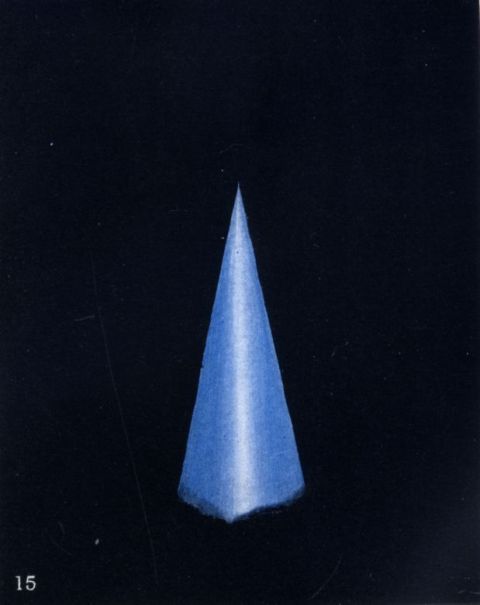
Yet sometimes in a humbler fane, in a church belonging to the unfashionable Catholic or Ritualist, or even in a lowly meeting-house where there is but little of learning or of culture, one may watch the deep blue clouds rolling ceaselessly eastward towards the altar, or upwards, testifying at least to the earnestness and the reverence of those who give them birth. Rarely—very rarely—among the clouds of blue will flash like a lance cast by the hand of a giant such a thought-form as is shown in Fig. 15; or such a flower of self-renunciation as we see in Fig. 16 may float before our ravished eyes; but in most cases we must seek elsewhere for these signs of a higher development.
Upward Rush of Devotion.—The form in Fig. 15 bears much the same relation to that of Fig. 14 as did the clearly outlined projectile of Fig. 10 to the indeterminate cloud of Fig. 8. We could hardly have a more marked contrast than that between the inchoate flaccidity of the nebulosity in Fig. 14 and the virile vigour of the splendid spire of highly developed devotion which leaps into being before us in Fig. 15. This is no uncertain half-formed sentiment; it is the outrush into manifestation of a grand emotion rooted deep in the knowledge of fact. The man who feels such devotion as this is one who knows in whom he has believed; the man who makes such a thought-form as this is one who has taught himself how to think. The determination of the upward rush points to courage as well as conviction, while the sharpness of its outline shows the clarity of its creator's conception, and the peerless purity of its colour bears witness to his utter unselfishness.
The Response to Devotion.—In Fig. 17 we see the result of his thought—the response of the Logos to the appeal made to Him, the truth which underlies the highest and best part of the persistent belief in an answer to prayer. It needs a few words of explanation. On every plane of His solar system our Logos pours forth His light, His power, His life, and naturally it is on the higher planes that this outpouring of divine strength can be given most fully. The descent from each plane to that next below it means an almost paralysing limitation—a limitation entirely incomprehensible except to those who have experienced the higher possibilities of human consciousness. Thus the divine life flows forth with incomparably greater fulness on the mental plane than on the astral; and yet even its glory at the mental level is ineffably transcended by that of the buddhic plane. Normally each of these mighty waves of influence spreads about its appropriate plane—horizontally, as it were—but it does not pass into the obscuration of a plane lower than that for which it was originally intended.
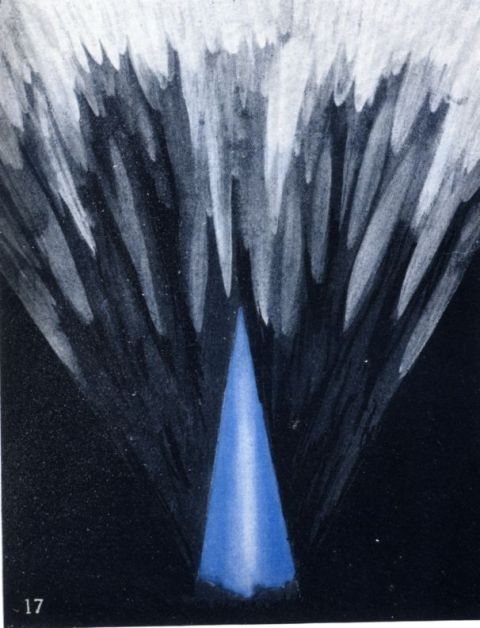
Yet there are conditions under which the grace and strength peculiar to a higher plane may in a measure be brought down to a lower one, and may spread abroad there with wonderful effect. This seems to be possible only when a special channel is for the moment opened; and that work must be done from below and by the effort of man. It has before been explained that whenever a man's thought or feeling is selfish, the energy which it produces moves in a close curve, and thus inevitably returns and expends itself upon its own level; but when the thought or feeling is absolutely unselfish, its energy rushes forth in an open curve, and thus does not return in the ordinary sense, but pierces through into the plane above, because only in that higher condition, with its additional dimension, can it find room for its expansion. But in thus breaking through, such a thought or feeling holds open a door (to speak symbolically) of dimension equivalent to its own diameter, and thus furnishes the requisite channel through which the divine force appropriate to the higher plane can pour itself into the lower with marvellous results, not only for the thinker but for others. An attempt is made in Fig. 17 to symbolise this, and to indicate the great truth that an infinite flood of the higher type of force is always ready and waiting to pour through when the channel is offered, just as the water in a cistern may be said to be waiting to pour through the first pipe that may be opened.
The result of the descent of divine life is a very great strengthening and uplifting of the maker of the channel, and the spreading all about him of a most powerful and beneficent influence. This effect has often been called an answer to prayer, and has been attributed by the ignorant to what they call a "special interposition of Providence," instead of to the unerring action of the great and immutable divine law.
Self-Renunciation.—Fig. 16 gives us yet another form of devotion, producing an exquisitely beautiful form of a type quite new to us—a type in which one might at first sight suppose that various graceful shapes belonging to animate nature were being imitated. Fig. 16, for example, is somewhat suggestive of a partially opened flower-bud, while other forms are found to bear a certain resemblance to shells or leaves or tree-shapes. Manifestly, however, these are not and cannot be copies of vegetable or animal forms, and it seems probable that the explanation of the similarity lies very much deeper than that. An analogous and even more significant fact is that some very complex thought-forms can be exactly imitated by the action of certain mechanical forces, as has been said above. While with our present knowledge it would be unwise to attempt a solution of the very fascinating problem presented by these remarkable resemblances, it seems likely that we are obtaining a glimpse across the threshold of a very mighty mystery, for if by certain thoughts we produce a form which has been duplicated by the processes of nature, we have at least a presumption that these forces of nature work along lines somewhat similar to the action of those thoughts. Since the universe is itself a mighty thought-form called into existence by the Logos, it may well be that tiny parts of it are also the thought-forms of minor entities engaged in the same work; and thus perhaps we may approach a comprehension of what is meant by the three hundred and thirty million Devas of the Hindus.
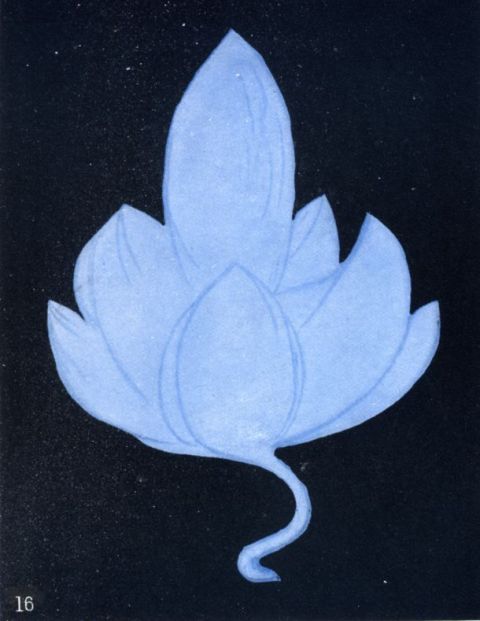 This form is of the loveliest pale azure, with a glory of white light shining through it—something indeed to tax the skill even of the indefatigable artist who worked so hard to get them as nearly right as possible. It is what a Catholic would call a definite "act of devotion"—better still, an act of utter selflessness, of self-surrender and renunciation.
