Masonic, Occult and Esoteric Online Library
Thought Forms
By Annie Besant
Intellect
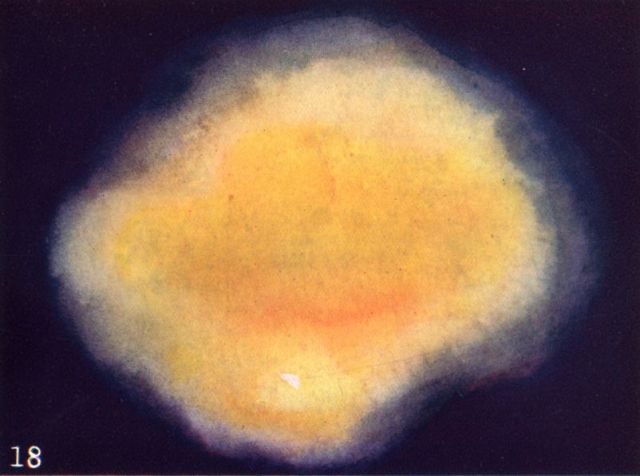
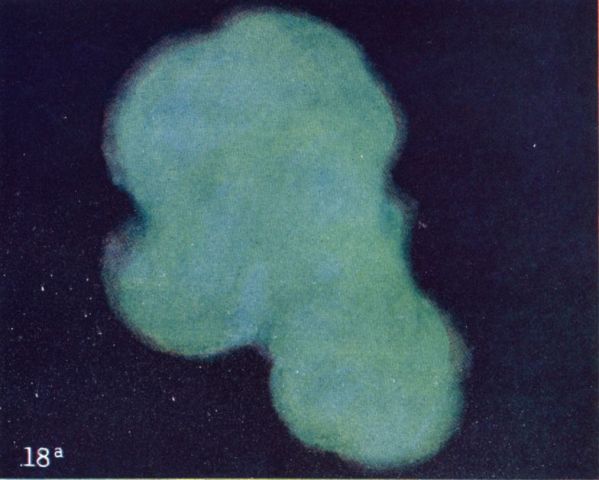
Vague Intellectual Pleasure.—Fig. 18 represents a vague cloud of the same order as those shown in Figs. 8 and 14, but in this case the colour is yellow instead of crimson or blue. Yellow in any of man's vehicles always indicates intellectual capacity, but its shades vary very much, and it may be complicated by the admixture of other hues. Generally speaking, it has a deeper and duller tint if the intellect is directed chiefly into lower channels, more especially if the objects are selfish. In the astral or mental body of the average man of business it would show itself as yellow ochre, while pure intellect devoted to the study of philosophy or mathematics appears frequently to be golden, and this rises gradually to a beautiful clear and luminous lemon or primrose yellow when a powerful intellect is being employed absolutely unselfishly for the benefit of humanity. Most yellow thought-forms are clearly outlined, and a vague cloud of this colour is comparatively rare. It indicates intellectual pleasure—appreciation of the result of ingenuity, or the delight felt in clever workmanship. Such pleasure as the ordinary man derives from the contemplation of a picture usually depends chiefly upon the emotions of admiration, affection, or pity which it arouses within him, or sometimes, if it pourtrays a scene with which he is familiar, its charm consists in its power to awaken the memory of past joys. An artist, however, may derive from a picture a pleasure of an entirely different character, based upon his recognition of the excellence of the work, and of the ingenuity which has been exercised in producing certain results. Such pure intellectual gratification shows itself in a yellow cloud; and the same effect may be produced by delight in musical ingenuity, or the subtleties of argument. A cloud of this nature betokens the entire absence of any personal emotion, for if that were present it would inevitably tinge the yellow with its own appropriate colour.
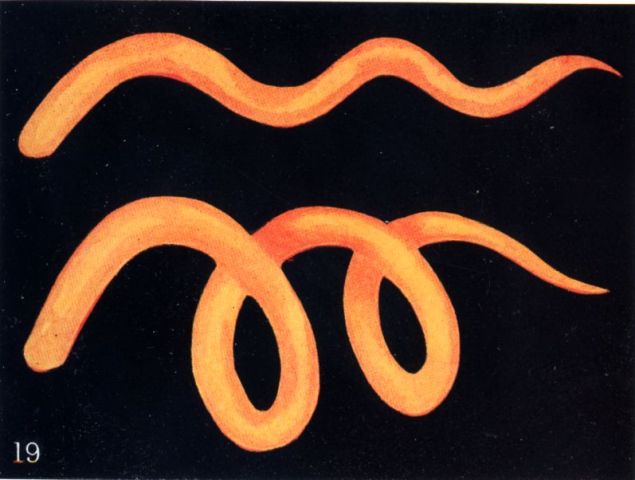
 The Intention to Know.—Fig. 19 is of interest as showing us something of the growth of a thought-form. The earlier stage, which is indicated by the upper form, is not uncommon, and indicates the determination to solve some problem—the intention to know and to understand. Sometimes a theosophical lecturer sees many of these yellow serpentine forms projecting towards him from his audience, and welcomes them as a token that his hearers are following his arguments intelligently, and have an earnest desire to understand and to know more. A form of this kind frequently accompanies a question, and if, as is sometimes unfortunately the case, the question is put less with the genuine desire for knowledge than for the purpose of exhibiting the acumen of the questioner, the form is strongly tinged with the deep orange that indicates conceit. It was at a theosophical meeting that this special shape was encountered, and it accompanied a question which showed considerable thought and penetration. The answer at first given was not thoroughly satisfactory to the inquirer, who seems to have received the impression that his problem was being evaded by the lecturer. His resolution to obtain a full and thorough answer to his inquiry became more determined than ever, and his thought-form deepened in colour and changed into the second of the two shapes, resembling a cork-screw even more closely than before. Forms similar to these are constantly created by ordinary idle and frivolous curiosity, but as there is no intellect involved in that case the colour is no longer yellow, but usually closely resembles that of decaying meat, somewhat like that shown in Fig. 29 as expressing a drunken man's craving for alcohol.
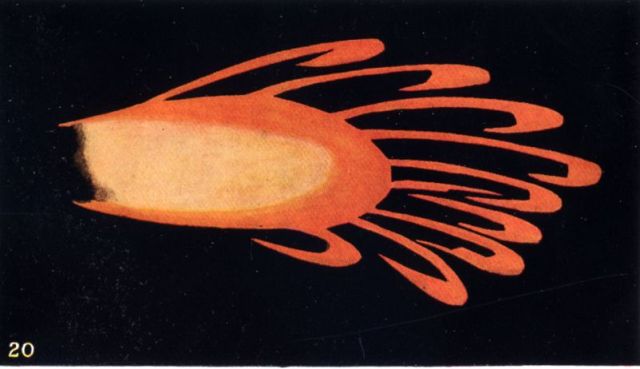
High Ambition.—Fig. 20 gives us another manifestation of desire—the ambition for place or power. The ambitious quality is shown by the rich deep orange colour, and the desire by the hooked extensions which precede the form as it moves. The thought is a good and pure one of its kind, for if there were anything base or selfish in the desire it would inevitably show itself in the darkening of the clear orange hue by dull reds, browns, or greys. If this man coveted place or power, it was not for his own sake, but from the conviction that he could do the work well and truly, and to the advantage of his fellow-men.
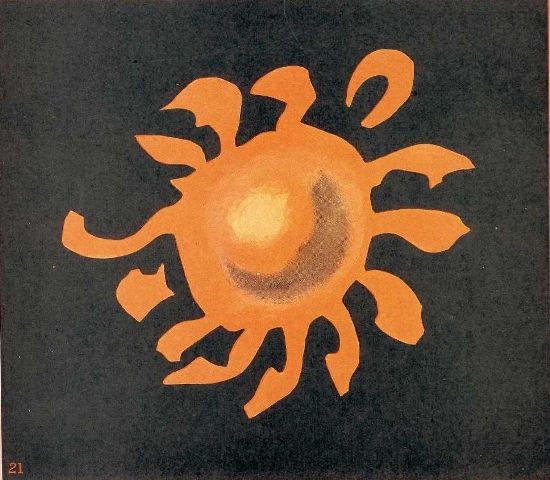
Selfish Ambition.—Ambition of a lower type is represented in Fig. 21. Not only have we here a large stain of the dull brown-grey of selfishness, but there is also a considerable difference in the form, though it appears to possess equal definiteness of outline. Fig. 20 is rising steadily onward towards a definite object, for it will be observed that the central part of it is as definitely a projectile as Fig. 10. Fig. 21, on the other hand, is a floating form, and is strongly indicative of general acquisitiveness—the ambition to grasp for the self everything that is within sight.
ANGER
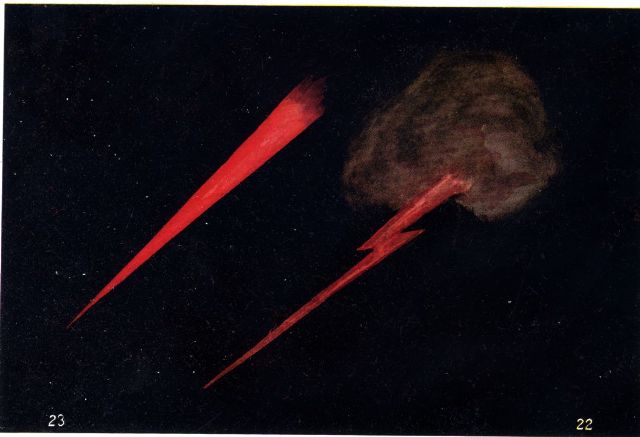
Murderous Rage and Sustained Anger.—In Figs. 22 and 23 we have two terrible examples of the awful effect of anger. The lurid flash from dark clouds (Fig. 22) was taken from the aura of a rough and partially intoxicated man in the East End of London, as he struck down a woman; the flash darted out at her the moment before he raised his hand to strike, and caused a shuddering feeling of horror, as though it might slay. The keen-pointed stiletto-like dart (Fig. 23) was a thought of steady anger, intense and desiring vengeance, of the quality of murder, sustained through years, and directed against a person who had inflicted a deep injury on the one who sent it forth; had the latter been possessed of a strong and trained will, such a thought-form would slay, and the one nourishing it is running a very serious danger of becoming a murderer in act as well as in thought in a future incarnation. It will be noted that both of them take the flash-like form, though the upper is irregular in its shape, while the lower represents a steadiness of intention which is far more dangerous. The basis of utter selfishness out of which the upper one springs is very characteristic and instructive. The difference in colour between the two is also worthy of note. In the upper one the dirty brown of selfishness is so strongly evident that it stains even the outrush of anger; while in the second case, though no doubt selfishness was at the root of that also, the original thought has been forgotten in the sustained and concentrated wrath. One who studies Plate XIII. in Man Visible and Invisible will be able to image to himself the condition of the astral body from which these forms are protruding; and surely the mere sight of these pictures, even without examination, should prove a powerful object-lesson in the evil of yielding to the passion of anger.
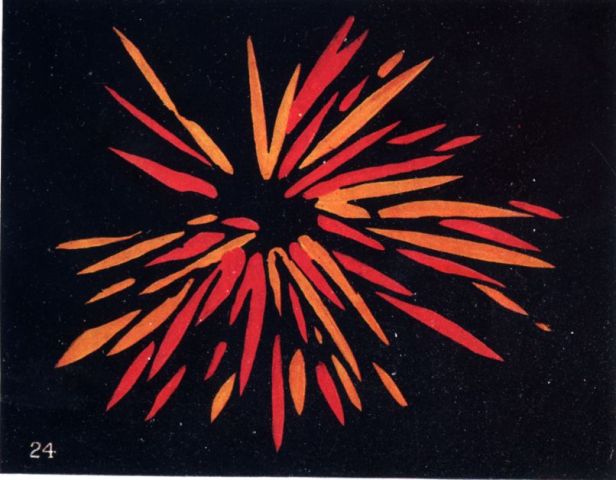
Explosive Anger.—In Fig. 24 we see an exhibition of anger of a totally different character. Here is no sustained hatred, but simply a vigorous explosion of irritation. It is at once evident that while the creators of the forms shown in Figs. 22 and 23 were each directing their ire against an individual, the person who is responsible for the explosion in Fig. 24 is for the moment at war with the whole world round him. It may well express the sentiment of some choleric old gentleman, who feels himself insulted or impertinently treated, for the dash of orange intermingled with the scarlet implies that his pride has been seriously hurt. It is instructive to compare the radiations of this plate with those of Fig. 11. Here we see indicated a veritable explosion, instantaneous in its passing and irregular in its effects; and the vacant centre shows us that the feeling that caused it is already a thing of the past, and that no further force is being generated. In Fig. 11, on the other hand, the centre is the strongest part of the thought-form, showing that this is not the result of a momentary flash of feeling, but that there is a steady continuous upwelling of the energy, while the rays show by their quality and length and the evenness of their distribution the steadily sustained effort which produces them.
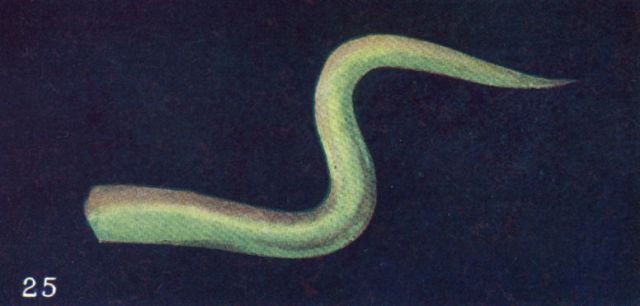
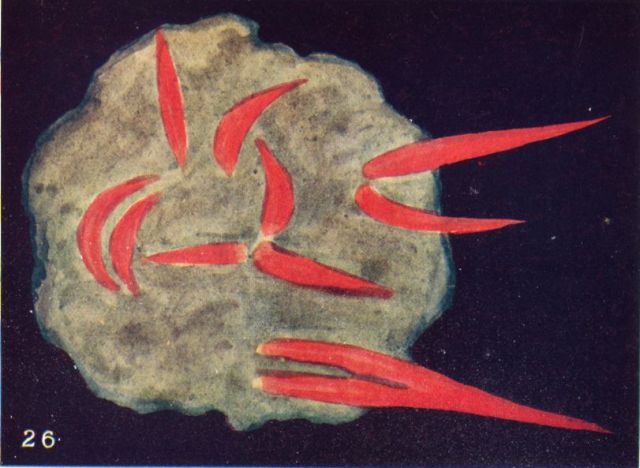
Watchful and Angry Jealousy.—In Fig. 25 we see an interesting though unpleasant thought-form. Its peculiar brownish-green colour at once indicates to the practised clairvoyant that it is an expression of jealousy, and its curious shape shows the eagerness with which the man is watching its object. The remarkable resemblance to the snake with raised head aptly symbolises the extraordinarily fatuous attitude of the jealous person, keenly alert to discover signs of that which he least of all wishes to see. The moment that he does see it, or imagines that he sees it, the form will change into the far commoner one shown in Fig. 26, where the jealousy is already mingled with anger. It may be noted that here the jealousy is merely a vague cloud, though interspersed with very definite flashes of anger ready to strike at those by whom it fancies itself to be injured; whereas in Fig. 25, where there is no anger as yet, the jealousy itself has a perfectly definite and very expressive outline.
Vague Sympathy.—In Fig. 18A we have another of the vague clouds, but this time its green colour shows us that it is a manifestation of the feeling of sympathy. We may infer from the indistinct character of its outline that it is not a definite and active sympathy, such as would instantly translate itself from thought into deed; it marks rather such a general feeling of commiseration as might come over a man who read an account of a sad accident, or stood at the door of a hospital ward looking in upon the patients.
FEAR
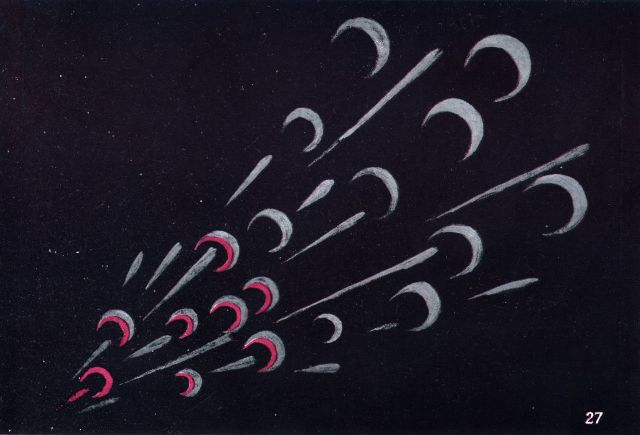
Sudden Fright.—One of the most pitiful objects in nature is a man or an animal in a condition of abject fear; and an examination of Plate XIV. in Man Visible and Invisible shows that under such circumstances the astral body presents no better appearance than the physical. When a man's astral body is thus in a state of frenzied palpitation, its natural tendency is to throw off amorphous explosive fragments, like masses of rock hurled out in blasting, as will be seen in Fig. 30; but when a person is not terrified but seriously startled, an effect such as that shown in Fig. 27 is often produced. In one of the photographs taken by Dr Baraduc of Paris, it was noticed that an eruption of broken circles resulted from sudden annoyance, and this outrush of crescent-shaped forms seems to be of somewhat the same nature, though in this case there are the accompanying lines of matter which even increase the explosive appearance. It is noteworthy that all the crescents to the right hand, which must obviously have been those expelled earliest, show nothing but the livid grey of fear; but a moment later the man is already partially recovering from the shock, and beginning to feel angry that he allowed himself to be startled. This is shown by the fact that the later crescents are lined with scarlet, evidencing the mingling of anger and fear, while the last crescent is pure scarlet, telling us that even already the fright is entirely overcome, and only the annoyance remains.
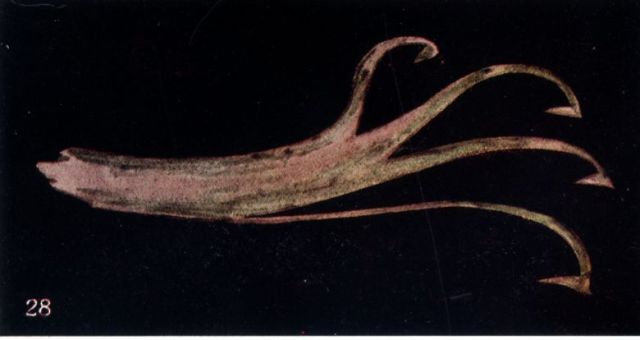
Selfish Greed.—Fig. 28 gives us an example of selfish greed—a far lower type than Fig. 21. It will be noted that here there is nothing even so lofty as ambition, and it is also evident from the tinge of muddy green that the person from whom this unpleasant thought is projecting is quite ready to employ deceit in order to obtain her desire. While the ambition of Fig. 21 was general in its nature, the craving expressed in Fig. 28 is for a particular object towards which it is reaching out; for it will be understood that this thought-form, like that in Fig. 13, remains attached to the astral body, which must be supposed to be on the left of the picture. Claw-like forms of this nature are very frequently to be seen converging upon a woman who wears a new dress or bonnet, or some specially attractive article of jewellery. The thought-form may vary in colour according to the precise amount of envy or jealousy which is mingled with the lust for possession, but an approximation to the shape indicated in our illustration will be found in all cases. Not infrequently people gathered in front of a shop-window may be seen thus protruding astral cravings through the glass.